08:00
Two inspectors arrive
They show their OHSC identification, ask for the practice manager and start with your documents.
There’s no scramble. Your sign has been green for weeks, and each measure shows the records behind it.
Inspections of private GP practices began in November 2025. Here’s what inspectors check, hour by hour, and what they’ll ask to see.
Here’s how a typical inspection runs, and what you’ll show at each step.
08:00
They show their OHSC identification, ask for the practice manager and start with your documents.
There’s no scramble. Your sign has been green for weeks, and each measure shows the records behind it.
08:40
They count all 23 items and read every expiry date. One expired ampoule of adrenaline is enough to fail.
Non-negotiableYour team checks it every week on a phone. Last week’s expiry dates carry over, and anything expiring within 30 days is flagged.

09:30
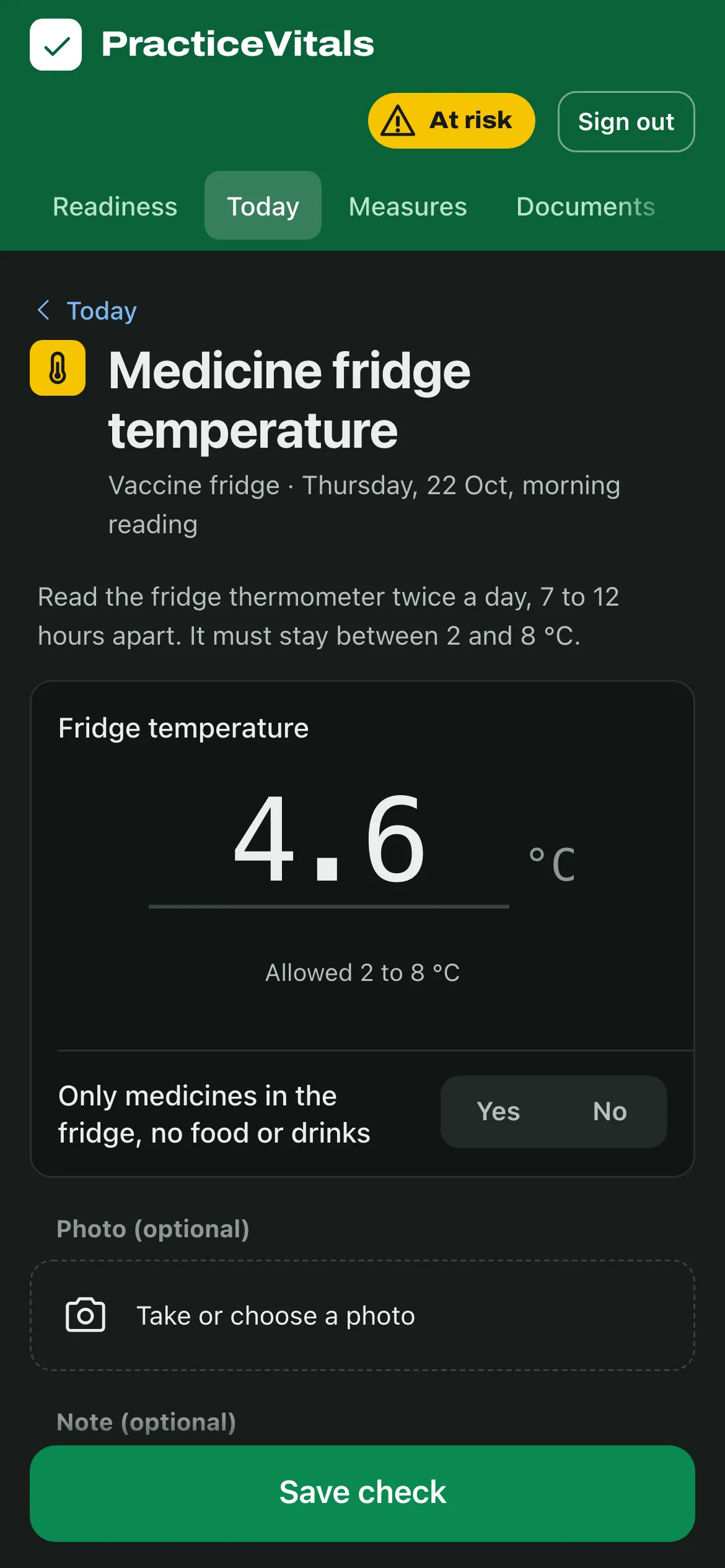
They ask for three months of temperatures, taken twice a day and all between 2 and 8 °C.
Every reading is there, with who took it and when. A reading outside 2 to 8 °C can’t be saved until someone notes what they did about it.
10:30
They read each procedure. It must be signed, reviewed in the last five years and cover every topic the tool lists.
Each one is signed, in date and complete. PracticeVitals won’t let a procedure be signed off until it covers every topic.

11:30
They check every complaint was closed with an outcome. They also audit some patient files and ask staff how urgent patients are seen first.
Every closed complaint has its outcome attached. File audits use file numbers, not patient names.

12:00
They leave with everything they asked for. A practice that complies gets a certificate valid for four years.
Tomorrow, the checks carry on as usual. You’re ready for the next one too.
Most of the inspection is records. You can’t go back and fill them in, so they have to build up day by day.
Every GP practice is scored on both.
If either one fails, the practice fails, however well it does on everything else.
PracticeVitals turns each of these into a daily or weekly job on your team’s phones. It also shows you what got missed.
Start your free trialSources: the OHSC’s GP inspection tool, version 1.1, in two parts. Administration and practice management and clinical care and support (both PDF).
It’s a visit by the Office of Health Standards Compliance to check that a practice meets South Africa’s national health standards. Inspections of private GP practices began in November 2025. Two inspectors spend about four hours at the practice. If it complies, it gets a certificate valid for four years.
Every GP practice is scored on two. The emergency trolley or bag must be complete and in date. And the oxygen must be ready: a cylinder above its minimum level, or a working concentrator with backup power. If either fails, the practice fails, however well it does on everything else.
Start at least three months before, because inspectors ask for three months of records. Work out which measures apply, and get your written procedures signed. Then check the trolley and oxygen every week, take the fridge temperature twice a day, and keep the complaints register up to date.
You’ll get a compliance notice with deadlines. If the problems aren’t fixed, the OHSC can fine the practice or withdraw its certificate.
A certificate lasts four years, and the OHSC says you’ll need one to contract with the NHI Fund.
No, we’re independent. PracticeVitals is built from the OHSC’s published GP inspection tool, version 1.1, and we update it when the OHSC revises the tool.
Try PracticeVitals free for 30 days. Answer ten questions and your checklist is ready.
Start your free trial